|
|
|
|
April 2026 MedTech highlights key developments, including Singapore achieving the highest WHO regulatory maturity level, China approving the world’s first invasive brain-computer interface medical device, and new healthcare initiatives in Malaysia, India, and Vietnam. Even with various regional conflicts, regulators and regulatory expertise still managed to gather in Singapore to work towards faster access and regulatory convergence – in relative comfort. Life still goes on, whatever the world presents us. Ditto with Access-2-Healthcare! |
|
|
|
|
|
|
|
|
|
WHAT ARE THE LATEST IN HEALTHCARE POLICIES TODAY? |
|
|
|
|
|
MedTech Capital fund launched to boost medical device innovation
|
|
Union Commerce and Industry Minister Piyush Goyal launched a MedTech Capital fund to accelerate innovation, research, and manufacturing in India’s medical device sector. The initiative is a partnership between Andhra Pradesh MedTech Zone (AMTZ) and MedArtha Capital. It will provide growth capital and strategic support to emerging medical device companies and aim to strengthen domestic manufacturing and build globally competitive MedTech firms.
|
|
|
|
|
|
|
|
Sunway Healthcare sets final price for US$722mil IPO, Malaysia's largest in nine years |
|
Malaysia's Sunway Healthcare set its final offering price at RM1.45 per share, in line with its earlier prospectus, aiming to raise RM2.86 billion (US$722.22 million) in what could be the country's largest listing in nearly a decade. The initial public offering (IPO) includes 1.97 billion shares priced at RM1.45 apiece for institutional and retail investors, representing a 17.1 per cent stake in the company, according to the prospectus. |
|
|
|
|
|
|
|
Proposal for 90 diseases requiring screening, diagnosis, and treatment before and after birth |
|
The Ministry of Health has proposed a list of 90 congenital diseases that require screening, diagnosis, and treatment to improve the effectiveness of newborn healthcare and prevent birth defects. The draft clearly states that the selection of congenital diseases to be included in the list must ensure the following principles: Prevalence and burden of the disease; Ability to screen and diagnose; Feasibility and socio-economic effectiveness.
|
|
|
|
|
|
|
|
|
|
|
|
ANNOUNCEMENTS FROM COUNTRIES WHERE WE HAVE A PRESENCE |
|
|
|
|
|
Stryker’s manufacturing and shipping were disrupted after the cyberattack
|
|
The medtech company, which identified the attack on 11 March 2026, revealed in an update that its order processing, manufacturing and shipping have been disrupted. Stryker maintained that the incident is contained to its internal Microsoft environment, and there is no malware or ransomware detected.
|
|
|
|
|
|
|
|
China approves market launch of brain-computer interface medical device in world first
|
|
China's National Medical Products Administration (NMPA) has recently approved the registration application for an Implantable Brain Computer Interface (BCI) for Hand Motor Augmentation, developed by Neuracle Technology (Shanghai) Co., Ltd., marking the world's first market launch of an invasive BCI medical device.
|
|
|
|
|
|
|
|
Announcement of the establishment of the “KYOTO-iCAP Fund III”
|
|
Kyoto University Innovation Capital Co., Ltd. ("Kyoto iCAP") (Headquarters: Sakyo-ku, Kyoto; Representative Director: Ko Kusumi) announced that it has established the Innovation Kyoto 2026 Investment Limited Partnership (KYOTO-iCAP Fund III), for which Kyoto iCAP serves as the general partner. The KYOTO-iCAP Fund III will invest in startups originating from Kyoto University and other Japanese national universities from the early stages of their development. |
|
|
|
|
|
|
|
|
|
|
|
Singapore achieves highest WHO Maturity Level for medical device regulation |
|
Singapore has become the first WHO Member State globally to achieve the highest maturity level (ML4) in WHO's classification of regulatory authorities for medical devices. This milestone signifies that Singapore, which falls under WHO’s Western Pacific Region, is managing a strong, quality-assured, and continually improving system for medical device regulation.
|
|
|
|
|
|
|
|
Therapeutic Goods Administration (TGA) published guidance "Software-based medical device exclusions" |
|
TGA has published guidance clarifying which software-based medical devices are excluded from regulation in Australia. The guidance outlines 15 software exclusion categories, noting that some software products may perform multiple functions; to qualify for exclusion, every function of the software must meet the exclusion criteria. |
|
|
|
|
|
Latest list of Designated Notified Bodies |
|
|
|
|
|
|
|
|
|
PRODUCT COMMERCIALISATION |
|
|
|
Articles to help your journey in commercialisation |
|
|
|
|
|
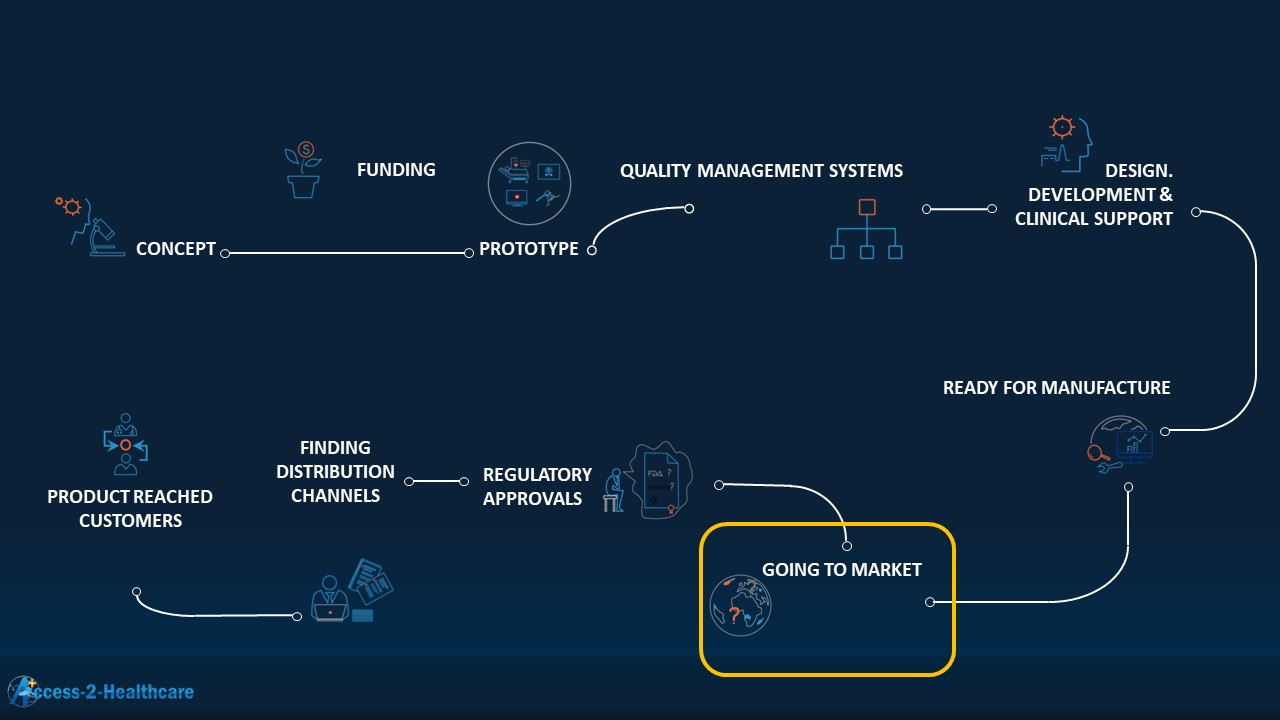
GO TO MARKET STRATEGY Making (the) Ends Meet – the algorithm and the engagement
Go to Market Strategy
Making (the) Ends Meet – the algorithm and the engagement. In the age of automation, algorithms, and artificial intelligence, is there any value of a secondary-research-based, high-level, go-to-market strategy?
Probably not, but then again, if the data isn’t accurate or curated, it was never useful in the first place.
Nothing beats going to the location of interest, but there’s this chicken n egg issue – if I don’t know much about the healthcare status of country X, why would I invest and travel? Isn’t that based on that same high-level go-to-market strategy?
No, it still depends on your own product’s initial value proposition.
Did it change the workflow? If yes, then how does it impact the healthcare system economically? A part of this now can be determined by a highly specific online search, and the other part is to see if your product indeed could bring about clinical AND economic value.
When it comes to algorithms, there are heaps to select from. If you are good at drafting search prompts (most of us are not), then even the simplest Gemini Pro or GPT would do the trip. But if there’s more help needed, then it’s either to have a person who knows how to translate to prompts, or to find some application that is more specific to these needs.
Either way, what will really be the game changer is the in-market visit: the people to meet, the questions to ask, and the stakeholders to convince. A part of it lies with all of the government trade enterprises that offer support to open doors, but getting the right person with the right questions for the answers desired is the final objective. Therefore, be prepared, well prepared with the necessary product demo, questions, and deal-breaking decision points ready.
If any of the above resonate, feel free to bounce ideas of us, because this part i.e., advisory, it’s free of charge!
|
|
|
|
|
|
|
|
|
|
|
|
|
|
|
|
The 29th IMDRF Management Committee Meeting, hosted by HSA, was held in Singapore from Monday, 9 March 2026 to Friday, 13 March 2026. This week-long event welcomed regulators and experts from around the world to gather and exchanging insights on the latest advancements in medical device regulation and technology, as well as on the strategic initiatives of the IMDRF. The first 2 days were for much industry-regulator sharing as we had the IMDRF – Industry Joint Workshop, and the Stakeholders Forum. The following 3 days were dedicated to the Committee Meeting itself to advance the working group items as well as the strategic objectives of the IMDRF.
For more information, visit About IMDRF | International Medical Device Regulators Forum
|
|
|
|
|
|
|
|
|
|
|
|
MedTech Gatherings happening in April 2026! |
|
|
|
China International Medical Equipment Fair (CMEF) 2026
National Exhibition and Convention Center, China
April 9–12, 2026
More info ⟶ |
Medtec Japan 2026
Tokyo Big Sight, Tokyo
April 21–23, 2026
More info ⟶ |
|
Digital Healthcare Innovation Summit (DHIS) 2026
Boston, USA
April 27–28, 2026
More info ⟶ |
DMEA 2026
Berlin, Germany April 21–23, 2026
More info ⟶ |
|
|
|
|
|
|
|
|
|
|
|
|
|
|
|
|
|
.png)
.png)
_(7).png)
.png)